Mount Purgatory
Mount Purgatory is the second realm of Dante Alighieri's afterlife, a towering island-mountain in the southern hemisphere where souls purge the seven deadly sins before ascending to Paradise. It is the central setting of the Purgatorio canticle, structured as seven concentric terraces, each dedicated to cleansing one capital vice through a specific contrapasso, and culminating in the Earthly Paradise at its summit. The mountain's unique geography, its prohibition on nocturnal ascent, and its role as the site of moral transformation distinguish it sharply from the static punishments of Hell and the eternal joys of Heaven.
Geography and Structure
Mount Purgatory rises from the waters of the southern ocean, the only landmass in that hemisphere. Its base is lapped by a shore where the Angel Pilot deposits souls ferried from the mouth of the Tiber. The mountain is divided into three main zones: the Ante-Purgatory at its foot, where souls who delayed repentance must wait; the seven terraces of Purgatory proper, each corresponding to one of the seven deadly sins; and the Earthly Paradise at the summit, the Garden of Eden that Adam and Eve once inhabited. The mountain's slope grows progressively easier as one ascends: Virgil explains to Dante that "at the beginning down below 'tis tiresome, and aye the more one climbs, the less it hurts" (E07363–E07368). This physical law mirrors the spiritual principle that the hardest part of moral reform is the first step, and that virtue becomes habitual and even pleasurable with practice. The mountain is also subject to a strict temporal rule: no one may ascend after nightfall. Sordello draws a line on the ground and tells Virgil and Dante that they cannot pass it once the sun has gone, not because any external barrier would stop them, but because the darkness itself would perplex the will and make progress impossible (E07363–E07368). This nocturnal prohibition reinforces the idea that moral growth requires the light of reason and grace.
The Seven Terraces and Purgation
Each of the seven terraces is devoted to purging one of the capital sins: Pride, Envy, Wrath, Sloth, Avarice, Gluttony, and Lust. The souls on each terrace undergo a punishment that directly counteracts the sin they committed in life. The proud, for example, are bent double under massive stones, forced to see the humility they lacked carved into the marble pavement beneath them. The envious have their eyes sewn shut with iron wire, their sight—the organ through which they begrudged others' good—now denied them. The wrathful walk in a thick, acrid smoke that blinds and chokes them, a physical manifestation of the anger that clouded their reason. The slothful run ceaselessly, driven by zeal to make up for the love of good they neglected. The avaricious lie prostrate on the ground, their faces pressed to the earth, because in life they fixed their gaze on earthly wealth instead of heaven. The gluttonous are emaciated, tormented by the sight and scent of fruit and water they cannot reach, their desire for food purified through unfulfilled longing. The lustful walk through a wall of fire, their impure passions burned away by the flames of divine love. Each terrace also features examples of the virtue opposed to the sin, either carved into the rock or shouted by passing angels, so that the souls are constantly reminded of what they should have been.
The Ante-Purgatory and the Gate
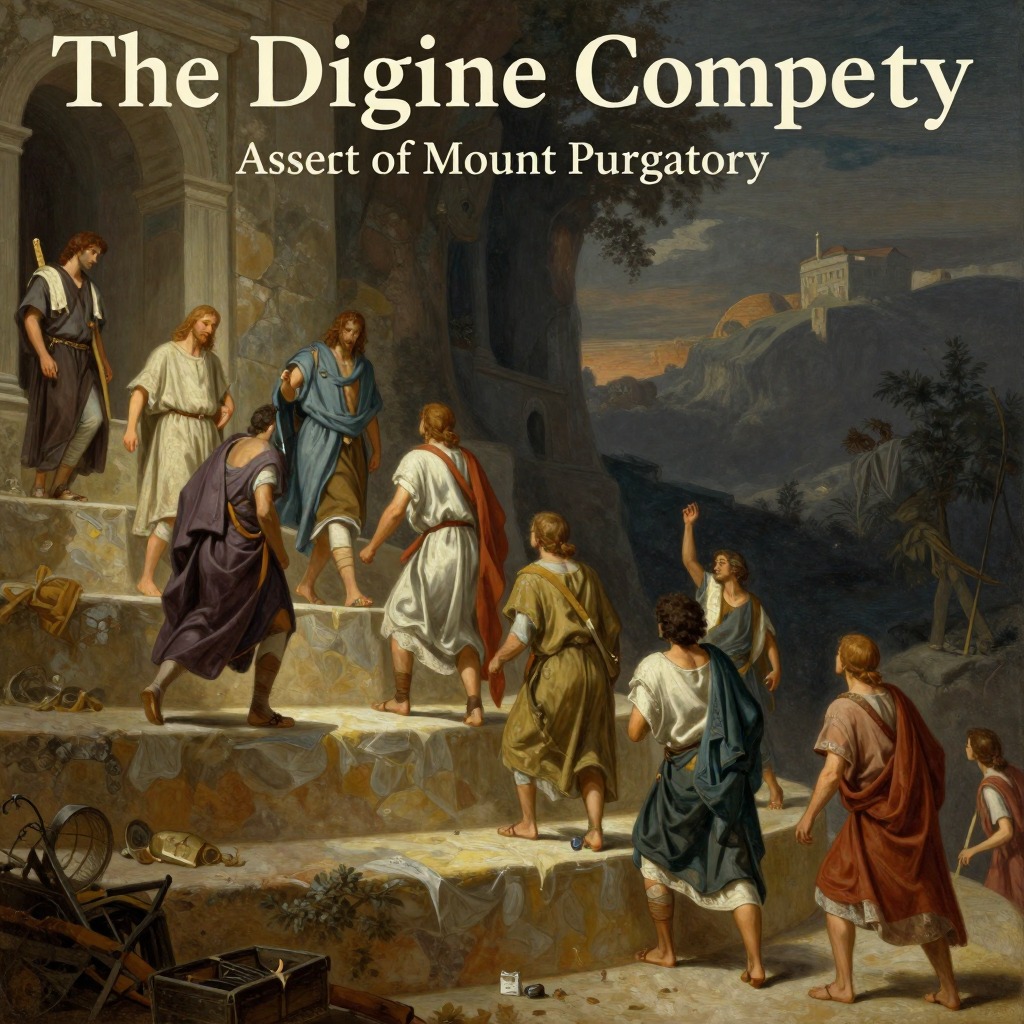
Before reaching the seven terraces, souls must pass through Ante-Purgatory, a region at the mountain's base where those who repented only at the last moment—or who died excommunicated but penitent—must wait for a period proportional to their delay. Among them are Manfredi, who shows Dante the wounds that killed him and explains that, though his body was cast out of the kingdom by the Archbishop of Cosenza, God's mercy is not limited by ecclesiastical curses; and Belacqua, a former friend of Dante's, who sits idly with his knees drawn up, too lazy to begin the ascent until the requisite time has passed. At the top of Ante-Purgatory stands the Gate of Purgatory, guarded by an angel holding a naked sword. The gate is approached by three steps: white marble, dark cracked stone, and porphyry red as blood. The angel inscribes seven P's (for peccata, sins) on Dante's forehead with the point of his sword, and warns that anyone who looks back after entering will be cast out. The P's are gradually erased as Dante ascends each terrace, a visible sign of the soul's progressive purification.
Narrative and Thematic Significance
Mount Purgatory is not merely a setting but an active agent in the poem's moral drama. Unlike Hell, where sinners are fixed forever in the state they chose on earth, Purgatory is a realm of change, hope, and growth. The mountain itself trembles with joy whenever a soul completes its purification and is ready to ascend to Heaven, and the entire mountain rings with the cry "Gloria in excelsis Deo" (E07363–E07368). This earthquake is a unique phenomenon, explained by Statius: it occurs only when a soul feels itself wholly pure and freely wills to move upward, and the divine justice that bound it to its penance now releases it. The mountain thus embodies the dynamic interplay between divine justice and human freedom. Its structure—ascending, lightening, and culminating in the Earthly Paradise—traces the path of the soul from the bondage of sin to the liberty of grace. The Earthly Paradise at the summit, where Dante meets Matilda, witnesses the allegorical procession of the Church, and is finally reunited with Beatrice, serves as the threshold between the temporal purgation of the mountain and the eternal beatitude of Heaven. Mount Purgatory is therefore the poem's central image of hope: a place where suffering is meaningful, where time is redemptive, and where every step upward brings the soul closer to God.